
Getting women into HE leadership calls for specific policies
In 2009, Egypt witnessed a historic moment when Professor Hind Hanafy became the first female university president at Alexandria University, located in the country’s second-largest city. However, progress in empowering women to assume leadership positions has been limited since then.
It was only in 2020 that Professor Reem Bahgat became the second female academic to be appointed as the rector of Egypt University for Informatics.
Despite the ongoing emphasis on female empowerment, equality and social justice in Egypt’s Vision 2030, the representation of women in senior leadership roles within higher education remains disappointingly low. Currently, less than 10% of such positions in Egypt are held by women, highlighting the need for further strides in promoting gender diversity and inclusivity in academia.
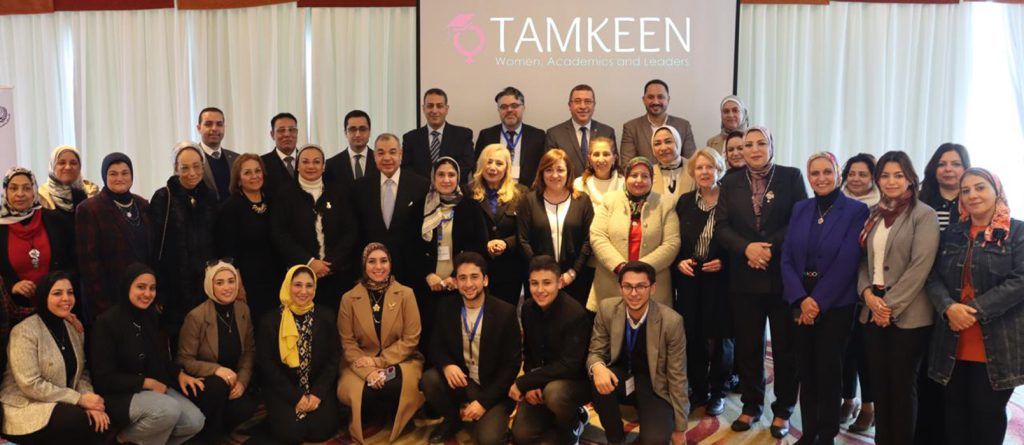
In 2023, we launched the Tamkeen project, funded by the British Council’s Going Global Partnerships programme. The primary objective was to address the under-representation of women in senior leadership roles within higher and further education in Egypt.
Our goal was to instigate a positive transformation in the lives of women and contribute to long-term gender equality. The project aimed to equip female academics with the tools needed to assume more strategic and senior leadership positions in the sector.
To gain insights into the key challenges impeding female academics from assuming leadership roles, we conducted a comprehensive survey involving over 125 academics, with 75% being female.
The survey included individuals from diverse academic ranks and fields across various higher education institutions, including public, national and private entities. The findings of our survey revealed two main categories of challenges – societal and institutional – that currently hinder female academics in Egypt from taking on senior leadership roles in the sector.
Societal challenges
The initial set of challenges highlighted by respondents revolves around societal stereotypes, discriminatory practices and traditional gender roles that place expectations on women to prioritise family responsibilities over career progression.
Respondents underscored the difficulty of balancing family obligations with demanding academic careers, emphasising that a leadership trajectory often involves extended work hours, research commitments and frequent travel – factors that may clash with traditional gender norms.
Additionally, persistent stereotypes regarding women’s leadership capabilities can impact their opportunities for career advancement.
According to the respondents, unconscious bias and discriminatory practices are prevalent in academic life in Egypt, leading to challenges stemming from implicit bias in hiring, promotion and access to resources, particularly when compared to their male counterparts. Consequently, addressing implicit bias is deemed crucial for establishing a more equitable and inclusive academic environment.
Institutional challenges
The challenges falling within the second category, organically stemming from the first, pose significant hurdles for female academics in Egypt. Respondents highlight that the inherent under-representation of women in leadership roles creates a formidable cycle. The absence of visible female role models makes it challenging for other women to envision themselves in leadership positions, consequently hindering career aspirations within academia.
Institutional challenges further compound these issues, with limited networking opportunities identified as a prominent concern. This underscores the imperative for female academics to gain access to mentors and supportive networks for effective career development.
Respondents also note challenges faced by female academics in securing essential resources for their academic work, including research funds and laboratory resources. Moreover, the lack of clear policies promoting gender diversity and equity within most universities in Egypt is a noteworthy concern.
This deficiency encompasses the absence of family-friendly policies, mentorship programmes and initiatives aimed at addressing gender-based discrimination. Addressing these institutional challenges is crucial for fostering an environment that enables the full participation and success of female academics in Egypt.
Operational level gaps
It is crucial to highlight that issues of empowerment, equality and social justice constitute core priorities in Egypt’s Vision 2030. However, there is a substantial gap at the operational level within universities that requires immediate attention in the coming years. The survey results underscore the pressing need for systematic advocacy and proactive initiatives.
These include the establishment of female academic networks and organisations, the implementation of mentoring programmes for female academics and the formulation of institutional policies aimed at advancing women’s leadership in higher education in Egypt.
The Tamkeen project implemented a micro-level mentoring scheme for Advance HE fellowships led by Coventry University and benefiting three senior female academics at the Arab Academy for Science, Technology and Maritime Transport. Such initiatives contribute to cultivating a culture of quality education in Egypt and promoting best practices by recognising the significant impact of hardworking and active female academics in the sector.
Creating networks for female academic leaders, supported by proactive government policies and initiatives in Egypt, is a crucial step towards achieving gender equality within higher education. These networks empower women to excel in leadership roles, collectively advocate for a just and equitable academic environment, foster inclusivity and drive positive societal and economic outcomes for the nation.
Networks: a strategic approach
In further support of female networks, the authors have secured funding from the British Council for the implementation of the Tashbeek project.
This initiative aims to establish female academic networks as a strategic approach to address and manage the under-representation of women in senior leadership roles in the Egyptian higher education sector.
Tashbeek focuses on five key objectives or actions:
- Shedding light on challenges linked to the under-representation of women in senior leadership roles,
- Recognising networks as a vital solution to the issue of under-representation,
- Developing and planning for the establishment of a real network for female academic leaders in Egypt,
- Establishing the network and its activities, and
- Disseminating change through policies and governmental support to address and manage the under-representation of women in senior leadership positions more effectively.
Without dedicated efforts to address gender disparities, progress may remain sluggish. Government policies related to leadership in Egyptian higher education may lack specific gender equity provisions or face challenges when it comes to effective enforcement. This underscores the essential need for specific policies promoting gender diversity and equity in academic life in Egypt.
Rami M Ayoubi is associate professor for research at the Centre for Global Learning at Coventry University, United Kingdom; editor-in-chief for the Journal of Marketing for Higher Education; and UK principal investigator for Tamkeen and Tashbeek projects funded by the British Council. E-mail: ad4550@coventry.ac.uk (corresponding author). Rasha Abd El Aziz Youssef is professor and head of the business information systems department at the Arab Academy for Science Technology and Maritime Transport, and Egypt principal investigator for the Tamkeen and Tashbeek projects. Hiba K Massoud is senior lecturer (associate professor) at Cardiff School of Management, Cardiff Metropolitan University, UK; and a contributor to Tamkeen survey design and workshops.